Why Your Attractiveness Score Changes Between Photos
2026-10-30
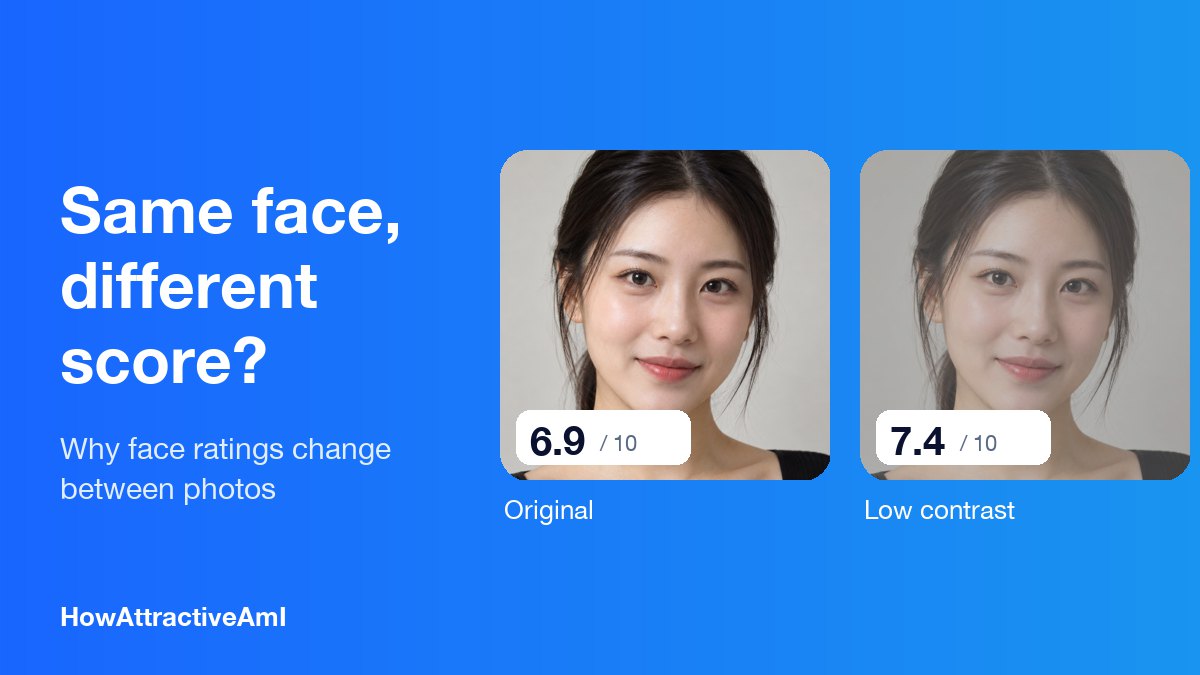
You upload a selfie and get a 6. You try another from last week and get an 8. A friend runs the same photo through a different site and gets a 9.5. The most common complaint about face rating tools, by a wide margin, is that the score will not sit still. In a set of Reddit threads we reviewed about these tools, inconsistent scores came up in 11 out of 15.
Some of that is the tools. Most of it is the photos. Here is what moves a face rating, how much, and how to take a photo that gives you a number you can trust.
1. Head angle: the biggest single factor
Measurement-based tools compare distances between points on your face. Turn your head a few degrees and the near side of your face gets wider in the photo while the far side gets narrower. Tilt your chin up and your lower face looks longer; tilt it down and your forehead does.
We saw this directly while calibrating our own engine. Four test photos with the head turned between 3.5° and 5° — small enough that you would not notice — scored between 79 and 83 for symmetry. After we added a correction that rotates the face back to straight-on using its 3D pose, the same four photos scored 93 to 95. A turn you cannot see cost more than ten points.
That is why a good tool either corrects head angle or refuses to score tilted photos. Ours does both: it corrects small turns and tilts, and asks for a new photo when the head is turned or tilted more than 10°.
2. Camera distance and lens distortion
Phone front cameras are wide-angle, and wide-angle lenses held close exaggerate whatever is nearest. A 2018 modelling study in JAMA Facial Plastic Surgery estimated that a selfie taken about 12 inches from the face makes the base of the nose look roughly 30% wider than a portrait taken from 5 feet (Ward et al.).
A wider-looking nose changes the mouth-to-nose ratio, the fifths of the face and how the midface reads. For a fair measurement, hold the phone at arm's length or ask someone to take the photo from a step or two away, then crop.
3. Smiling and expression
A smile moves the mouth corners outward, lifts the cheeks, raises the lower eyelids and changes the angle of the jaw. All of those are measurement points. One Reddit user reported going from 6.7 to 8.1 on a rating site just by smiling in the second photo. Squinting changes eye height and canthal tilt the same way.
Measurement tools should be fed a neutral face: lips closed and relaxed, eyes open, looking straight into the lens. Our photo check flags smiles and closed eyes so you know when expression may be affecting the result.
4. Lighting, filters and skin tone
Lighting matters in two different ways depending on the tool. Tools that use a trained model to "judge" the whole image can be swayed by skin, lighting and filters — Reddit users report that clear skin, good light and even whitening filters raise their scores on some sites.
Geometry-based tools only care where the landmarks land, so lighting matters less. We tested this: four photos, each brightened, darkened, lowered in contrast and run through a whitening filter. Brightness and contrast changes moved scores by at most half a point, from small shifts in where landmarks were detected. The whitening filter moved them by 0.2 at most, up for some photos and down for others — it does not raise the score. Filters that reshape the face, like slimming or eye enlarging, are a different story: they change the geometry, so they change the result.
5. Different tools measure different things
Two sites can give the same photo very different scores because they are not measuring the same thing. Some score a handful of ratios. Some use a model trained on how people rated other faces. Some ask a chatbot, which can give a different answer depending on how you phrase the question. And the scales themselves differ: PSL runs from 1 to 8 with a middle around 4, while most sites use 1–10.
Many sites also skew high. A 2024 study in Facial Plastic Surgery & Aesthetic Medicine had five AI rating websites and a human panel score the same 40 faces: the websites averaged 6.9 out of 10, the humans 5.0 (Goshtasbi et al.). When we ran one of our test photos through three popular tools, one gave it 83/100, another 9.5/10 and "top 1%", and the third would not score it without a side photo.
6. What a consistent tool should do
- Same photo, same score. Fixed measurements and a fixed formula, not a model that answers differently each time.
- Check the photo first. Flag or refuse tilted heads, smiles, closed eyes and tiny faces.
- Correct small head turns instead of punishing them.
- Show its working. Draw the lines it measured on your photo and list the numbers behind the score.
- Use an honest scale. If almost everyone gets an 8, the number tells you nothing.
That is how we built the attractiveness test; the full formula is on our methodology page.
7. How to take a photo for a fair face rating
- Camera at eye level, at arm's length or further. Not from above, not from below.
- Face the lens straight on. Keep your head level — imagine a line through both eyes parallel to the floor.
- Neutral face: lips relaxed and closed, eyes open, no squint.
- Soft, even light from the front, like a window you are facing. Avoid strong overhead or side light.
- Hair off the forehead and jawline, glasses off, no face-reshaping filters or beauty mode.
- Use the same setup every time if you want to compare results over weeks or months.
FAQ
Why did I get a different score on the same photo?
On a measurement-based tool you should not: the same photo always gets the same score here. Tools that use AI models or chatbots to judge a photo can give a different answer each time, and resizing or re-saving a photo can shift landmark detection very slightly.
Which photo gives my real score?
The one closest to a passport-style photo: straight on, eye level, arm's length, neutral face, even light. Selfies taken close up, from above or while smiling are the least reliable.
Does smiling make you more attractive in a face rating?
People often find a smile more attractive in real life, but for measurement tools a smile moves the mouth, cheeks, eyes and jaw points and makes the geometry less accurate. Rate a neutral photo; smile in your profile pictures.
Are AI face rating sites accurate?
They are consistent at measuring geometry when the photo is good, and they correlate with human ratings, but many inflate scores and none capture everything people find attractive — skin, hair, style, expression and personality all matter.
Why do different apps give me different scores?
They measure different features, weight them differently, use different scales, and some are tuned to flatter. Compare results within one tool using the same photo setup rather than across tools.